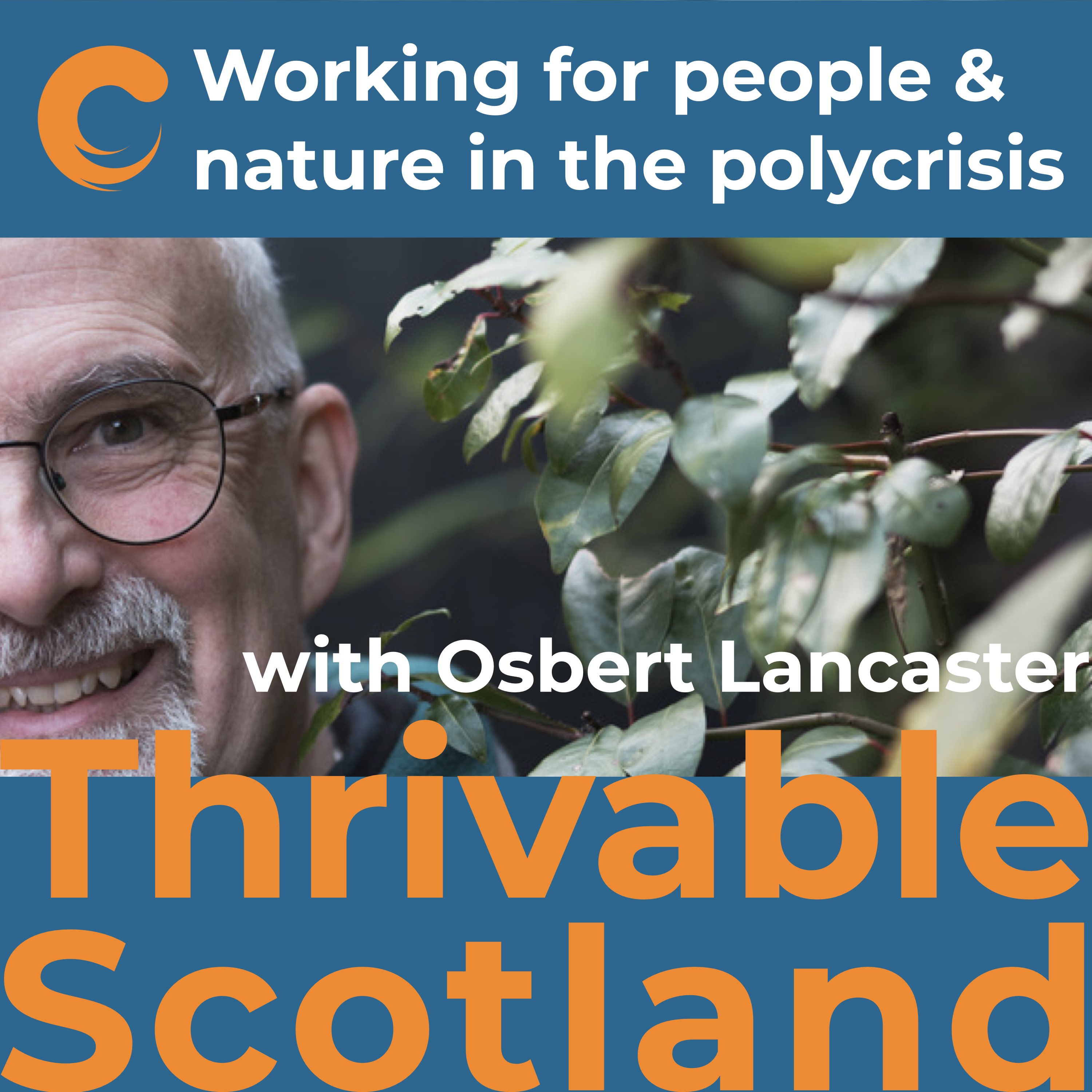
Discover Thrivable Scotland
If you're working to make the world a better place, I think you'll find my new Thrivable Scotland podcast inspiring and useful.
I'm Osbert Lancaster and after working in sustainability for 30 years I've decided we need to try a fresh approach.
In this short trailer I'll tell you how Thrivable Scotland came about and what you can expect, including:
👉 The three key elements of this new approach: focus on thriving, not survival; focus on the present, not the future; focus on what's working, not what's wrong.
👉 How I'll be interviewing people across Scotland who are building resilience, regenerating natural systems and healing society.
👉 How with my co-host Morag Watson and guest listeners, I'll be discussing how lessons from successful projects can be shared, scaled and applied in different contexts.
Listen to this trailer to find out more!
Transcript
I'm Osbert Lancaster and I want to tell you a bit about the background
2
:to my new podcast, Thrivable Scotland,
and to let you know what you can expect.
3
:When I started working in sustainability,
I felt part of a growing movement
4
:that had a real chance of creating
a better fairer world where we would
5
:live within the planet's limits.
6
:Now, 30 years later, climate change
is accelerating, natural systems
7
:are collapsing, and society seems
to be heading for breakdown.
8
:It seems to me that our old vision of
sustainability is no longer achievable.
9
:Is survival in a harsh and dangerous
world the best we can hope for?
10
:And this isn't just about the
future, it's also about right now
11
:too many people in this country
and across the world are living in
12
:difficult, precarious situations.
13
:On top of that, we have the cost of
living crisis and increasingly fragile
14
:global food system wars, political
instability, and so much more.
15
:I've been thinking about all this for a
while now, wondering whether all the work
16
:that countless people have been doing
for so long to create a better world was
17
:worthwhile wondering what I should do now?
18
:After all, we used to think
that once everyone knew about
19
:climate change, politicians
would be forced to take action.
20
:But now most people do know.
21
:And it seems like as a society,
we're carrying on as usual, either
22
:oblivious to what's happening
or hiding our heads in the sand.
23
:Any rational analysis shows that we're
facing very real challenges to the ways of
24
:life we're used to and that we'd want for
our children and for future generations.
25
:It is easy to talk about how bad the
situation is and that we need to take
26
:urgent action, but we, the environment
movement or the sustainability movement,
27
:or whatever you call it, has been
doing that for years, myself included.
28
:If telling people how bad it has worked,
we wouldn't be where we are today.
29
:I've come to believe we need to
try a different approach, and this
30
:approach has three key elements.
31
:One, stop emphasising all the
challenges we face and how our
32
:survival depends on tackling them.
33
:Instead of survival, focus on thriving
and work to create the conditions
34
:for people and nature to thrive.
35
:Two, stop trying to inspire
people with a better future.
36
:For ages we've been
promising jam tomorrow.
37
:If people make sacrifices today,
why should people believe us now?
38
:Instead, focus on jam today by
helping people and nature to thrive
39
:right now and into the future.
40
:And three, stop worrying
about what's wrong.
41
:I'm not suggesting we ignore the problems,
but if we fixate only on the problems,
42
:we are setting ourselves up to burn out.
43
:Instead, focus on what's
already working and how we can
44
:have more of what's working.
45
:This is the approach I'm
taking with Thrivable Scotland.
46
:I'll not be talking about
the actual approach much.
47
:Instead, I'll be putting it into practise.
48
:I'll be going out and about taking a
walk with people across the country
49
:who are working to build resilience,
regenerate nature, and heal society,
50
:I'll be talking with them about
their work and their projects.
51
:I'll be asking, what are you doing?
52
:Why does it matter?
53
:And what's working.
54
:Now, I have a bit of an issue
with good news stories, and I've
55
:discovered that I'm not the only one.
56
:I've tried subscribing to positive
newsletters and magazines, but the
57
:stories generally leave me feeling flat.
58
:So often it feels like too little given
the scale of the problems we face.
59
:I think the issue is that these
publications rarely make any connection
60
:between the projects, and any
plausible way in which we can make
61
:a meaningful difference ourselves
given the scale of the crises.
62
:That's why I'm trying to go further
in this Thrivable Scotland podcast.
63
:When I meet people doing great work I'll
not just be asking what they are doing.
64
:I'll be asking them why it's working,
and then back in the studio, I'll
65
:be joined by my co-host, Morag
Watson and expert guest listeners.
66
:Together we'll discuss the interview
we've just heard and dig into how
67
:what works could be shared and scaled
and applied in different contexts.
68
:Since starting to interview people for
this podcast, I've met so many amazing
69
:people doing great work, building
resilience, regenerating nature, and
70
:healing society in Scotland, not just
in areas you might expect like nature
71
:conservation and community agriculture,
for example, but also in social housing,
72
:the health service, and in politics.
73
:If you are working to make the
world a better place, whether you're
74
:in the public, private or third
sector, I hope you'll find these
75
:stories, insights, and lessons
fascinating, inspiring, and useful.
76
:I'm Osbert Lancaster, this
is Thrivable Scotland.
77
:I'll be releasing a full episode
on the first Friday of the
78
:month, plus occasional, extra
episodes from time to time.
79
:I hope you'll join me and be part of this
amazing community of change makers as we
80
:explore what's working in the polycrisis.